If you’ve ever loaded up Counter-Strike and wondered what those badges next to player names actually mean, you’re not alone.
The CSGO ranking system isn’t just cosmetic—it’s the backbone of competitive matchmaking, determining who you face and how the game measures your skill.
Whether you’re grinding through Silver or pushing for Global Elite, understanding how ranks work can drastically change your approach to climbing the ladder.
The system has 18 distinct tiers, each representing a significant jump in player ability, game sense, and consistency.
But it’s not just about winning matches. The algorithm considers round performance, individual impact, and match outcomes to place you where you belong.
CSGO Ranking System
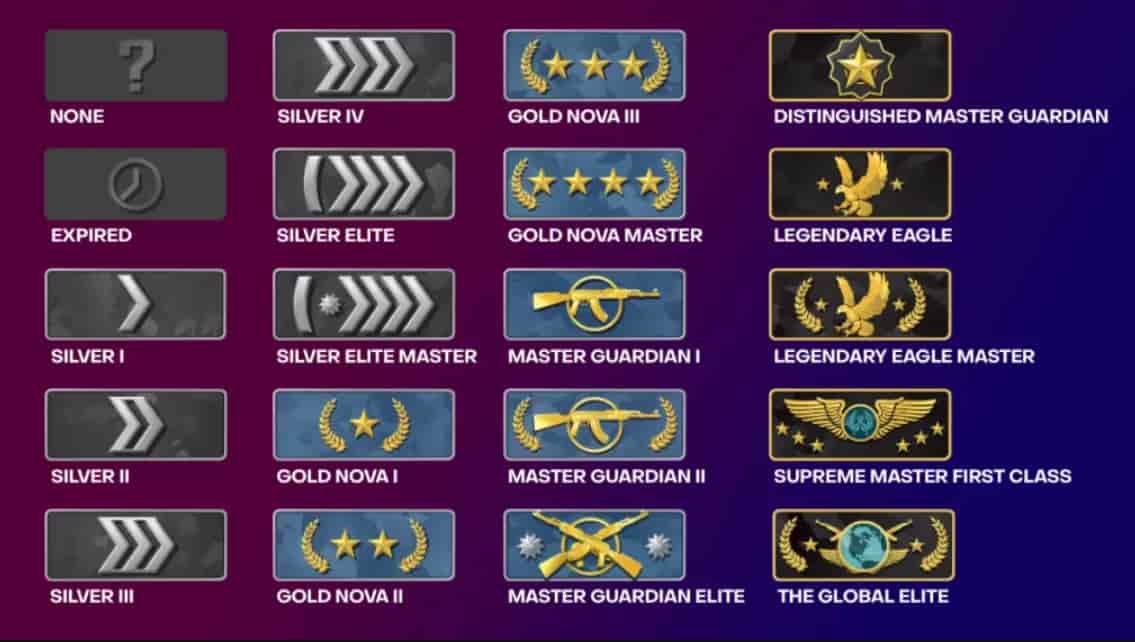
CSGO Ranking System
How the CSGO Ranking System Actually Works
- The CSGO ranking system uses a modified Glicko-2 rating model, though Valve has never publicly confirmed the exact formula.
- What we do know is that your rank reflects your overall competitive performance across multiple factors.
- You earn or lose rank progress based on match results, but individual round wins, MVPs, and performance against higher-ranked opponents all influence the speed of your progression.
- When you first start playing competitive mode, you’ll need to win 10 placement matches.
- During this period, the system evaluates your skill level and assigns your initial rank.
- Most new players land somewhere between Silver I and Gold Nova II, though smurfs and naturally gifted players can place higher.
- The ranking system constantly recalibrates.
- If you take an extended break from competitive play, your rank becomes invisible until you complete a placement match.
- This prevents rank inflation and ensures returning players are properly placed based on current skill levels.
Complete CSGO Rank Names and Tier Breakdown
Here’s every rank in the competitive hierarchy:
Silver Tier:
- Silver I (S1)
- Silver II (S2)
- Silver III (S3)
- Silver IV (S4)
- Silver Elite (SE)
- Silver Elite Master (SEM)
Gold Nova Tier:
- Gold Nova I (GN1)
- Gold Nova II (GN2)
- Gold Nova III (GN3)
- Gold Nova Master (GNM)
Master Guardian Tier:
- Master Guardian I (MG1)
- Master Guardian II (MG2)
- Master Guardian Elite (MGE)
- Distinguished Master Guardian (DMG)
Eagle Tier:
- Legendary Eagle (LE)
- Legendary Eagle Master (LEM)
Elite Tier:
- Supreme Master First Class (SMFC)
- Global Elite (GE)
Each tier represents a noticeable increase in mechanical skill, positioning awareness, and tactical understanding.
The jump from Silver to Gold Nova requires basic aim control and map knowledge.
Moving from Gold Nova to Master Guardian demands economy management and coordinated team play.
Reaching the Eagle ranks means you’re consistently executing advanced strategies and reading opponent tendencies.
CSGO Rank Distribution: Where Do Most Players Land?
Understanding where you sit in the overall player population adds valuable context to your rank.
According to community-compiled data from sources like CSGO ranking system Reddit discussions, the distribution isn’t evenly spread across all 18 ranks.
| Rank Tier | Approximate Player % | Skill Characteristics |
|---|---|---|
| Silver I – IV | 15-20% | Learning basics, inconsistent aim |
| Silver Elite – SEM | 18-22% | Developing fundamentals |
| Gold Nova I – III | 25-28% | Solid fundamentals, learning tactics |
| GNM – MG2 | 15-18% | Consistent mechanics, team-oriented |
| MGE – DMG | 8-10% | Advanced positioning, utility usage |
| LE – LEM | 4-6% | High-level execution, adaptability |
| SMFC – Global | 1-3% | Elite performance, near-perfect fundamentals |
The Gold Nova ranks contain the largest concentration of players, making them the true “average” skill bracket.
If you’re Gold Nova III, you’re literally in the middle of the player base—not bad, not exceptional, just typical.
This distribution means climbing becomes progressively harder as you move up, since you’re competing against increasingly smaller pools of skilled players.
CS2 Ranking System: What Changed From CSGO
- When Counter-Strike 2 launched, Valve introduced significant changes to how competitive ranking works. The CS2 ranking system moved away from the traditional 18-tier badge system in Premier mode, implementing a numerical rating instead.
- In CS2 Premier ranks, players now receive a specific rating number (ranging from roughly 1,000 to 35,000+) rather than a badge. This CS2 rank distribution provides more granular feedback on your standing and makes progression feel more tangible. You can see exactly how many rating points you gain or lose after each match.
- However, CS2 still maintains the traditional rank badges for non-Premier competitive modes. This dual system lets players choose their preferred ranking experience—precise numerical ratings for serious grinders or classic badge progression for casual competitive play.
How CS2 Ranks Compared to CSGO
- The transition from CSGO to CS2 left many players wondering where they’d land in the new system. While Valve performed a soft reset during the transition, the underlying skill assessment remained similar. Most players found themselves placed slightly lower initially, requiring a few dozen matches to recalibrate to their true skill level.
- The CS2 XP ranks (separate from competitive ranks) also replaced the older service medal system, tracking overall account progression through casual and competitive play. These don’t affect matchmaking but provide long-term goals and cosmetic rewards.
- One key difference: CS2’s Premier rating system makes rank decay more transparent. If you don’t play for weeks, you’ll see your rating uncertainty increase, potentially leading to larger swings when you return.
Expert Insight: The Psychology of Rank Climbing
- Here’s something most guides won’t tell you—your mindset matters as much as your aim. Players who focus obsessively on their rank often tilt faster, make desperate plays, and blame teammates. The best climbers treat rank as a byproduct, not a goal.
- Focus on specific improvement areas instead. Spend one week perfecting your smoke lineups. The next week, review demos to fix positioning mistakes. Rank progression follows skill development, not the other way around. Players who grind 50 matches in a weekend hoping to magically rank up often end up deranking from burnout and frustration.
- The most consistent rank climbers maintain a 52-55% win rate over hundreds of matches. They don’t need massive winning streaks—just slightly better-than-average performance sustained over time. If you’re hard stuck at a rank for 100+ matches, you belong there until you identify and fix specific weaknesses.
Common Pitfalls That Keep Players Stuck
- Economy Mismanagement: Lower-ranked players frequently force-buy at terrible times or save when they should eco with the team. Understanding when to buy, when to save, and when to force is crucial for winning crucial rounds.
- Solo Play Mentality: Even if you’re the best aimer in the lobby, playing for individual highlights instead of team rounds caps your rank potential. CS:GO rewards coordinated executes and trades more than solo hero plays.
- Ignoring the Meta: Each rank tier has its own meta strategies. What works in Silver (rushing every round) gets punished in Master Guardian. Adapt your playstyle as you climb.
- Blame Culture: If you’re constantly convinced your teammates are holding you back, you’ve stopped looking for your own mistakes. Even in losing matches, top players find areas to improve.
Frequently Asked Questions
- How many wins does it take to rank up in CSGO?
There’s no fixed number. Rank progression depends on overall performance, not just wins. You might rank up in 5 wins against higher-ranked opponents or need 10+ wins if you’re barely winning close matches.
- Can you lose your rank in CSGO?
Your rank becomes hidden if you don’t play competitive for several weeks. You’ll need to win one match to display it again, and you might derank depending on how the player base shifted during your break.
- What’s the hardest rank to escape in CSGO?
Gold Nova Master and Distinguished Master Guardian are notorious skill plateaus. These ranks require transitioning from mechanical skill to tactical play, which many players struggle with.
- Do kills matter more than wins for ranking up?
Wins matter most, but individual performance (MVPs, kill differential, round impact) influences how quickly you progress. Losing 16-14 with 30 kills affects your rank less than losing 16-2 with 8 kills.
- Is the CS2 Premier ranking better than the old system?
It depends on preference. Premier’s numerical rating provides clearer feedback, while traditional badges feel more prestigious. Both systems use similar skill assessment underneath.
Final Thoughts
The CSGO ranking system isn’t perfect—smurfing, hackers, and inconsistent teammates will frustrate you at times.
But it remains one of gaming’s most refined competitive ladders, pushing millions of players to improve daily.
Your rank is a snapshot of your current skill, not a permanent label.
Whether you’re grinding through Silver or maintaining Global Elite, remember that every rank teaches valuable lessons.
Focus on consistent improvement, maintain a positive mindset, and the ranks will follow. The system works when you work with it, not against it.
Also Check:
About the Author