In Counter-Strike 2, communication separates average players from dangerous ones. Knowing where your teammates are, where enemies push, and how to respond in real time depends entirely on one thing: callouts.
all cs2 inferno callouts explained is a topic every serious player needs to understand. Inferno is not a simple map. It rewards teams that communicate clearly and punish those who do not.
The tactical depth here is real. Banana, Mid, Apps — each area demands precise calls and coordinated utility. Get it right, and Inferno becomes one of the most rewarding maps in the pool.
All CS2 Inferno Callouts Explained
All CS2 Inferno Callouts Explained
Knowing the layout is one thing. Calling it correctly under pressure is another. All CS2 Inferno Callouts Explained exists as a concept because this map has more named positions than most players realise, and using the wrong callout — or none at all — costs rounds.
- Why Callouts Matter A single misidentified position can send your entire team rotating the wrong way. Clear callouts eliminate confusion, speed up decision-making, and turn five individuals into a functioning unit.
- Active Duty Importance Inferno sits in the Active Duty map pool, meaning it appears at every level of competitive play from Premier to professional tournaments. Understanding its callouts is not optional if you are playing ranked seriously.
- Comparison to Other Maps Every map in the pool has its own callout language. CS2 Mirage callouts centre around Mid control and A Ramp aggression. CS2 Nuke callouts are vertical and complex, built around inside and outside pressure. Ancient callouts CS2 are newer and still being standardised by the community. Overpass callouts CS2 rely heavily on connector and canal positioning. Inferno sits apart from all of them — its callouts are among the oldest and most stable in the game’s history.
Inferno CS2 Callouts Guide
Inferno’s layout divides cleanly into T-side approaches, site positions, and the middle of the map. Understanding each section builds the foundation for every callout you will use in a match.
- T Spawn The starting point for the Terrorist side each round. From here, teams commit to Banana, Mid, or Apps. Split decisions made at T Spawn define the entire round structure.
- CT Spawn The Counter-Terrorist starting area. CTs use this to rotate between A and B through Library, Arch, or the CT corridor. Calling pressure early here forces faster rotations.
- Banana The long, open corridor connecting T Spawn to B Site. This is one of the most contested areas on the map every single round. Utility trades happen constantly here. Calling Car, Sandbag, and Logs positions during the fight tells your team exactly where enemies are holding.
- B Site Core Positions Coffins sits at the front of B Site with a direct sightline toward Banana — historically named after the coffins that used to be there, now replaced by scaffolding. Dark is a tight cubby in the corner, difficult to clear and easy to abuse post-plant. Fountain dominates the center of the site and controls open space. Quad, the tall scaffolding at the back, provides elevation and angles that are hard to challenge from a standard entry position.
- Mid and Second Mid Mid control is the backbone of T-side map pressure on Inferno. Holding or winning Mid opens split options onto both A and B. Second Mid runs parallel and connects through Underpass. Teams that own this space early dictate the tempo of the entire half.
- Apartments and Short Apps is the long interior corridor leading toward A Site. It connects through Balcony and down into Boiler before reaching Short. Historically referenced in both CS Inferno callouts and original CS 1.6 Inferno callouts, this path has always been a key route for early T aggression. Short itself is the open area immediately before A Site from the Apps side.
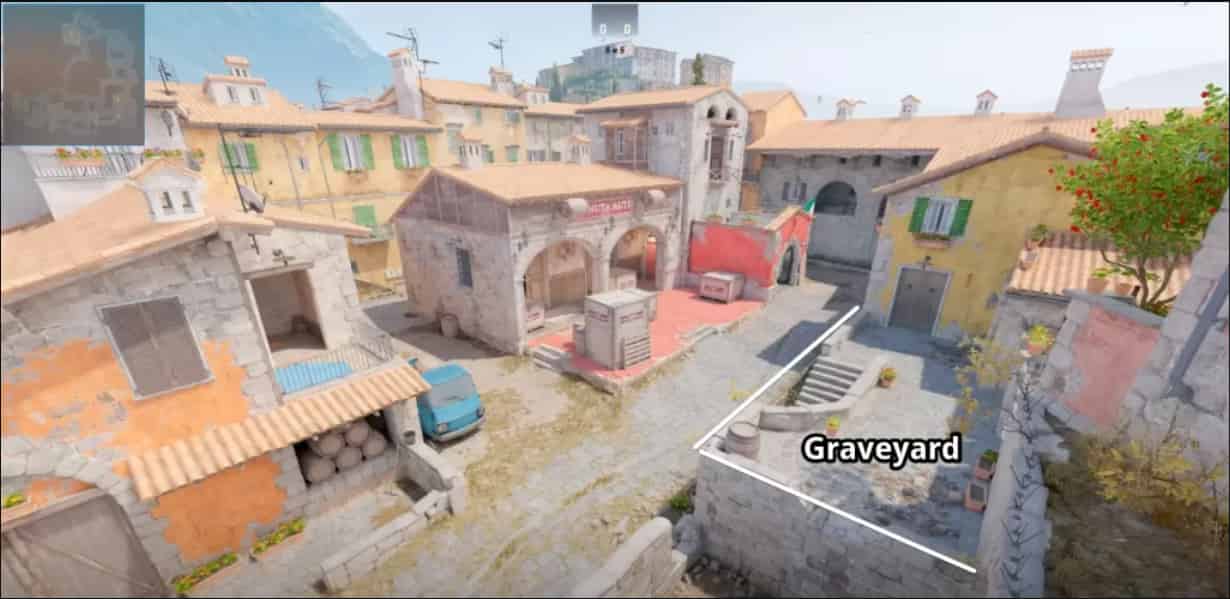
- A Site Positions Pit sits in the walled corner of A Site and extends under Balcony — a nightmare to clear and a strong defensive hold. Graveyard is the elevated area at the back, often used for post-plant positioning. Library connects CT Spawn directly to A Site and is a critical rotation path. Arch is the covered entryway from CT Spawn into Long, used by CTs rotating to defend A. These positions are consistent across all formats, including Inferno callouts wingman, where map control is compressed but the site positions remain identical.
CS2 Inferno Callouts List (2026)
| Area | Map Section | Common Use | Strategic Value |
|---|---|---|---|
| T Spawn | T Side | Round Start | Split Setup |
| CT Spawn | CT Side | Round Start | Rotation Base |
| Banana | B Approach | Entry Control | Utility Battles |
| Coffins | B Site | Anchor Position | Post-Plant Hold |
| Dark | B Site | Hidden Hold | Surprise Defense |
| Fountain | B Site | Center Control | Open Space Denial |
| Quad | B Site | Elevated Hold | Angle Advantage |
| Mid | Center Map | Map Control | Split Pressure |
| Second Mid | Center Map | Parallel Control | Underpass Access |
| Apps | A Approach | Interior Push | Fast Execute |
| Boiler | A Approach | Transition Point | Short Entry |
| Balcony | Apps / A Link | Overwatch Position | Window Control |
| Short | A Approach | Pre-Site Entry | Fast A Hit |
| Pit | A Site | Defensive Hold | Difficult Retake |
| Graveyard | A Site | Back Position | Post-Plant Cover |
| Library | CT Rotation | Connector | Retake Setup |
| Arch | CT to Long | Entry to Long | CT Rotation Path |
Competitive Meta Impact
- Banana Defines Rounds Every B-side round on Inferno is shaped by what happens in Banana. The team that wins the utility exchange and clears — or holds — Car and Sandbag sets the terms for the entire site hit. Calling these positions precisely during the fight determines whether your team commits or retreats.
- Apps Pressure Rotations A strong Apps push forces CT rotations away from B. Even a partial commitment through Apps draws attention. Calling the push early gives your team the information needed to either execute fully or bait a rotation and swing elsewhere.
- Mid Controls Tempo Mid is not just a pathway — it is a pressure multiplier. Teams that take Mid early open the possibility of splitting A or attacking Second Mid for Underpass access. Calling Mid control lets your IGL make informed calls about where the round goes next.
Conclusion
all cs2 inferno callouts explained is not just a learning task for new players. It is a competitive requirement at every level of the game.
Inferno rewards teams that communicate with precision. Every position on this map has a name, and using those names correctly wins rounds.
- Banana Control Is Mandatory Winning or holding Banana sets up B-site rounds entirely. Losing it without calling it costs everyone.
- Apps Creates Space A well-called Apps push draws resources away from A Site and opens split opportunities across the map.
- Communication Wins Games All CS2 Inferno Callouts Explained is only useful if you actually use the callouts in-game. Learning the names is the first step. Calling them clearly under pressure is what separates good players from great ones.
Also Check:
About the Author